

Sudden Change in Middle East Situation and Global Market Turmoil: US-Iran Deal Reached, Super Central Bank Week Begins
Introduction
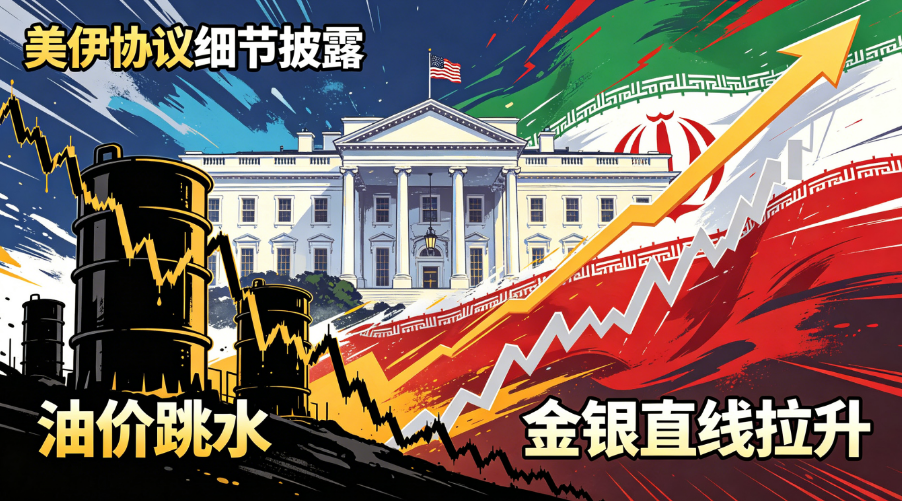
Global financial markets experienced violent swings on June 14-15, triggered by U.S. President Trump's social media announcement that the U.S.-Iran agreement 'is now complete' and authorized the Strait of Hormuz 'free passage,' with the U.S. Navy immediately lifting related blockades. This news quickly reversed market expectations for Middle East geopolitical risk, leading to a sharp drop in international oil prices and a surge in safe-haven asset prices. Meanwhile, this week brings 'Super Central Bank Week,' with the Fed, Bank of Japan, Bank of England, and others announcing rate decisions, plus OpenAI CEO's visit to South Korea and the G7 summit, intertwining major events to inject high uncertainty into the global economy and financial markets.
I. Sudden Change in Middle East: US-Iran Deal and Market Turmoil
Deal Details and Immediate Market Reaction
According to Xinhua, Trump confirmed on the 14th that the US-Iran deal was complete, followed by a statement from Iran's Supreme National Security Council formally confirming the ceasefire memorandum of understanding. Iran's Deputy Foreign Minister Gharibabadi noted the signing ceremony will be held on the 19th in Switzerland, followed by 60 days of talks on sanctions relief, nuclear issues, and economic reconstruction.
The news immediately triggered sharp reactions in financial markets. Spot gold opened on June 15 at $4,282.96/oz, up over 2%; silver also crossed $70/oz, rising over 3%. The rally in safe-haven assets contrasted sharply with oil's collapse—WTI crude futures at one point fell 5%, Brent crude down 4%. Market funds quickly exited crude futures, and net USD long positions shrank notably, with long-term allocation funds retreating.
Oil Market Fundamentals and Supply-Demand Outlook
Despite the short-term risk premium fading, crude fundamentals remain tight. Global inventory drawdowns are accelerating, and the supply gap will not be immediately filled by the deal. Iran stressed that before the 60-day talks begin, the U.S. must first fulfill commitments to end hostilities, lift blockades, and unfreeze assets. The Strait of Hormuz will reopen after the memorandum is signed on the 19th, meaning the restoration of energy transport routes will take days, leaving room for near-term oil price volatility.
Additionally, the G7 summit on June 15-17 in France is expected to urge Trump to support the European-led mine-clearing mission in the Strait of Hormuz. If implemented, this would further secure waterway safety and depress oil risk premiums.
II. 'Super Central Bank Week' Arrives: Diverging Global Monetary Policies
Federal Reserve: Warsh's Debut, Rates on Hold
At 2:00 a.m. Beijing time on June 18, the Fed will announce its rate decision, with new Chair Kevin Warsh making his policy debut. According to CME FedWatch, the market probability of rates unchanged in June is 98.5%, and only 1.4% probability of a cut in July. Inflation pressure and labor market resilience keep the Fed on hold, but easing Middle East tensions could weaken energy's push on inflation, adding variables to the policy path.
Bank of Japan: Governor Absent, Rate Hike Expectations High
The BOJ will meet on June 15-16, with Governor Ueda hospitalized, the first absence since 1998. Market expectations for a rate hike this meeting are as high as 88%, with Deputy Governor Uchida presiding over the post-meeting press conference. However, Nomura warns that the governor's absence will make subsequent policy communication 'extremely complex.' Whether dovish-leaning Premier Takichi High will seize the opportunity to influence BOJ decisions becomes a new focus for the market.
Other Central Banks: Australia, UK on Hold; Emerging Markets Diverge
This week also features rate decisions from the Bank of England, Reserve Bank of Australia, Brazil, Indonesia, and others. Markets generally expect the RBA to hold at 4.35% and the BOE at 3.75%. Emerging markets show divergence: Brazil expected to cut 25bp to stimulate, while Indonesia and the Philippines each raise 50bp to combat currency depreciation and inflation. The 'fragmentation' trend in global monetary policy is increasingly evident.
III. Tech and Corporate Developments: OpenAI CEO Visits South Korea Again, Amazon Launch Mission
Beyond macro and geopolitical events, the tech sector also brought important news. OpenAI CEO Sam Altman arrived in South Korea on June 14, meeting with Samsung Electronics DX division executives and staff on the 15th, and discussing collaboration with Kakao CEO Jung Shin-ah. This is Altman's second visit in 8 months, just days after Jensen Huang's visit to South Korea in early June, highlighting South Korea's key role in the semiconductor and AI ecosystem.
Amazon plans to execute the 'Leo Europe 3' launch mission on June 17, using an Ariane 6 rocket to deploy 36 satellites for its satellite constellation, with larger capacity per launch than before. This marks accelerated expansion of Amazon's LEO satellite network, intensifying competition with SpaceX Starlink.
Conclusion
This week, global financial markets are fighting on multiple fronts simultaneously: Middle East geopolitical risk suddenly cools, prompting repricing of safe-haven and risk assets; Super Central Bank Week tests the independence and communication capabilities of various central banks; and moves by tech giants continue to affect supply chains and investor sentiment. In the near term, markets will closely watch the formal signing of the US-Iran memorandum on the 19th, and central banks' statements on inflation and growth trade-offs. Amid uncertainty, investors should remain cautious and flexibly adjust asset allocation.