Sunrun Partners with Tesla and Renew Home to Build Virtual Power Plant, Targeting AI Era Electricity Demand
Keywords: Sunrun, Tesla, Renew Home, virtual power plant, flexible energy capacity, AI data center, grid efficiency
Introduction
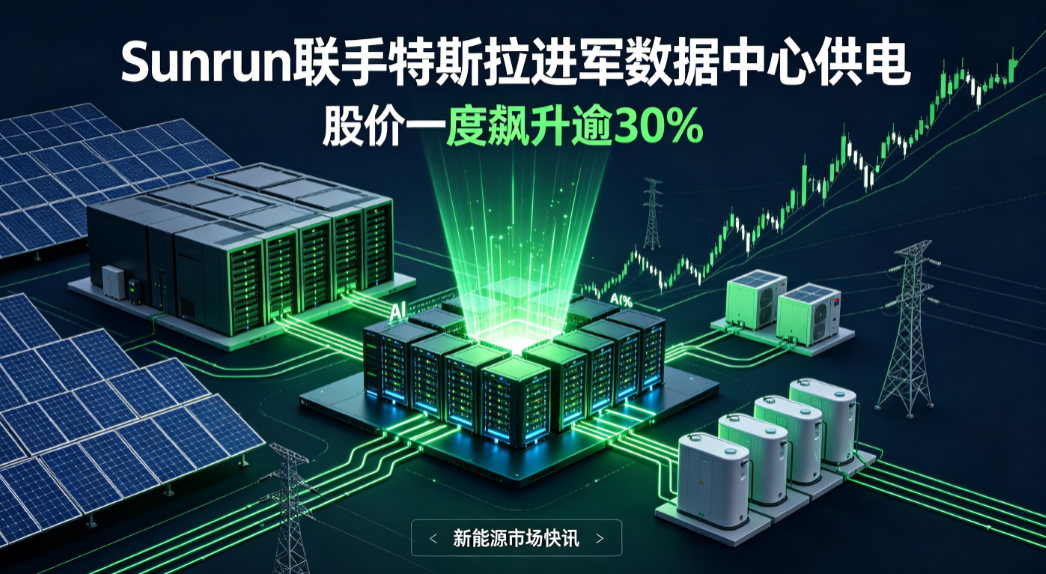
Against the backdrop of soaring electricity demand driven by the global AI boom, US residential solar provider Sunrun saw its stock surge over 31% at one point, hitting a near three-month high. The direct trigger was the company's announcement of a groundbreaking agreement with electric vehicle giant Tesla and smart home energy management platform Renew Home: the three will jointly provide over 16 gigawatts (GW) of "flexible energy capacity" to hyperscale data centers and utilities. This not only offers a new solution to the currently strained US power grid but also marks the scale-up of the distributed energy aggregation business model.
Tripartite Collaboration Creates 'Localized Turnkey' Power Platform
According to Sunrun's official statement on June 24, the cooperation framework aims to integrate millions of existing demand-side and energy output devices across US states into a "localized turnkey solution." The core is that without requiring power purchasers to invest additional hardware, software, grid interconnection, water, or land resources, distributed energy can be rapidly dispatched.
Specifically, the platform will integrate hundreds of thousands of residential storage batteries operated by Sunrun and Tesla, and 8 million smart thermostats managed by Renew Home. These devices, controlled via cloud intelligence, can form a virtual power plant that quickly releases stored power or adjusts load during grid peak times or when data centers need to reduce operation. These power resources will be prioritized for AI data center developers on a first-come, first-served basis, while also supplied to PJM Interconnection LLC, the largest US grid operator, to help maintain grid stability.
Addressing Grid Bottlenecks Under AI Boom
The explosive growth of AI technology has exponentially increased data center electricity demand, putting huge pressure on aging US grid infrastructure. Sunrun CEO Mary Powell pointed out in the statement: "The 19th-century grid cannot meet the innovation needs of 2026." Current US power infrastructure is configured for only a few peak hours, leaving expensive generation resources idle most of the time.
This collaboration offers a breakthrough solution: by aggregating distributed energy, starting distributed power plants during the most expensive and stressful hours of the day, helping data centers get needed power while avoiding costly new infrastructure costs for US households. Sunrun cited a Brattle Group report that improving existing grid efficiency could save the US $110 billion to $170 billion in electricity costs over the next decade and significantly speed up data center grid connections.
Win-Win-Win: Model for Customers, Communities, and Economy
From a business model perspective, this agreement creates multiple wins. For residential users, installing solar panels and home storage not only saves on electricity bills but also earns additional income by participating in the virtual power plant. For data center developers, reliable power can be obtained quickly without waiting for lengthy transmission line construction. For utilities, flexible resources can be dispatched at low cost, avoiding huge grid upgrade investments.
Industry analysts believe that Sunrun's collaboration with Tesla and Renew Home effectively turns millions of households into shareholders of a "virtual power plant." This distributed, agile energy supply model is expected to become mainstream in the US power market. As AI and cloud computing expand, companies that can integrate demand-side resources and provide real-time response capabilities will occupy a key strategic position in the energy transition.
Conclusion
Sunrun, Tesla, and Renew Home's alliance is not only a shot in the arm for capital markets but also provides a replicable template for global energy transition. In addressing the twin challenges of climate change and AI computing power explosion, releasing the hidden 'energy flexibility' of billions of households through intelligent integration of existing devices may be the most practical and economical way to solve future power supply-demand imbalances.