Title: Thailand Investment Hits New High: Industrial Transformation and Future Outlook Driven by Digital Economy
Keywords: Thailand investment, BOI, digital industry, data center, AI, electronics industry, clean energy, foreign direct investment, smart and sustainable industry, supply chain
Body
I. Introduction: Investment Milestone Breaks Trillion Baht
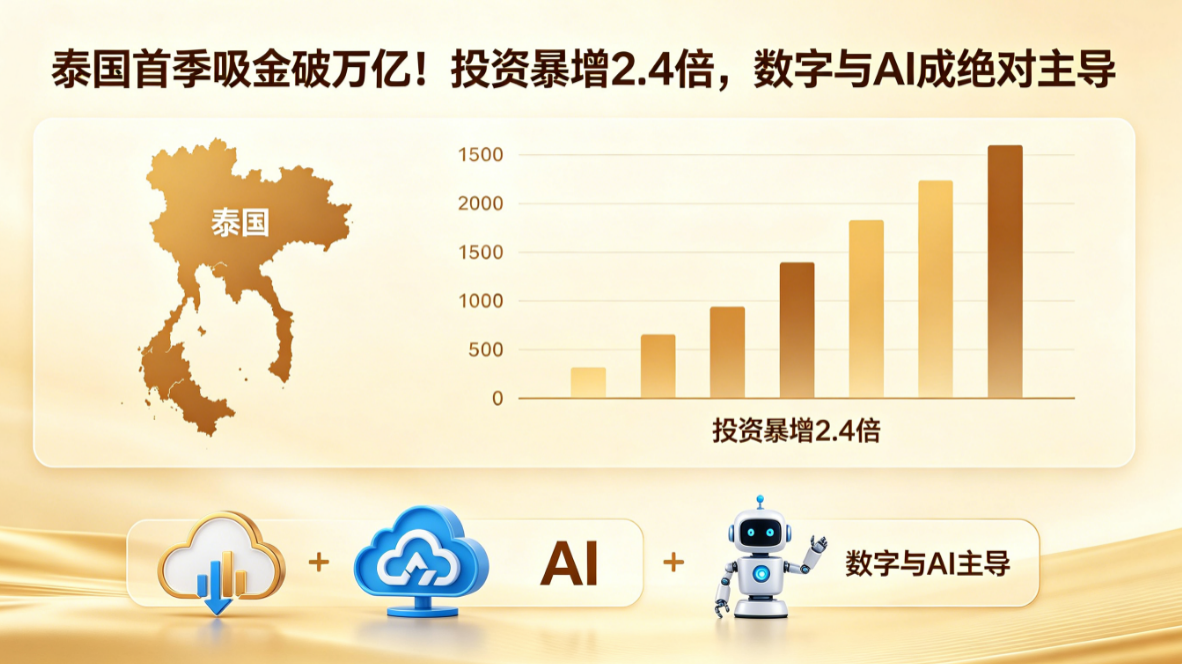
Against a backdrop of global economic turmoil and rising geopolitical risks, Thailand, a key Southeast Asian economy, is showing increasing investment attractiveness. Recently, Thailand's Board of Investment (BOI) Secretary-General Mr. Narit announced Q1 2026 investment promotion application data, with one milestone figure particularly eye-catching: in Q1 alone, 624 projects applied for investment promotion, with total investment of 1.016962 trillion baht, surging 2.4 times YoY. This astonishing growth is not just a leap in numbers but reveals a strong momentum in Thailand's transformation from a traditional manufacturing base to a high-tech future industry center. Especially large investment projects in digital and electronics industries are springing up, indicating investor confidence in Thailand as a regional tech hub has reached unprecedented levels. This article provides an in-depth analysis of this Q1 investment report, examining the underlying industrial structure changes, foreign capital trends, and policy direction, and looks ahead to Thailand's new role in the future global supply chain.
II. Investment Engine: Rise of Digital Industry and AI Supply Chain
(A) Digital Industry: Absolute Dominance of 'New Infrastructure'
Undoubtedly, the digital industry is the absolute star of this investment boom. According to the report, the digital industry accounted for 86% of total investment, with 873.741 billion baht across 48 projects. The vast majority went to data centers and cloud services. This is no accident, but a natural result of global digital transformation, the explosion of AI technology, and surging demand for cloud services. Leading companies from Singapore, Japan, the UK, and Malaysia, such as TikTok Systems, Skyline Data Center and Cloud Services, Global Switch, and Evolution Data Centre, have chosen to set up in Thailand.
These projects are not just building server rooms; their deeper significance lies in significantly strengthening Thailand's position as a regional digital infrastructure and AI hub. Data centers are the 'heart' of the digital economy, placing high demands on stable electricity, network, cooling systems, and geographic location. Thailand's stable electricity supply, relatively solid infrastructure, and central location in Southeast Asia make it an ideal site for data centers, especially hyperscale ones. As AI training and inference demand sees exponential growth in computing power, Thailand is gradually building a complete AI industry chain—from underlying computing power support to upper-level application services—with its strategic value being reassessed by global capital.
(B) Electronics and Electrical Industry: 'Driver' of Supply Chain Upgrade
Following the digital industry is the electronics and electrical industry, with investment of 40.456 billion baht across 80 projects. The investment in this area is characterized by 'advanced and precision' and 'industrial upgrading.' It focuses on the production of high-end electronic components, printed circuit boards, and key equipment for data centers, such as hard disk storage devices, optical communication equipment, and servers for AI data centers.
Notably, these investments mostly come from global leading players in the industry, such as Multi-Fineline Electronics (US), Celestica, Inventec (Taiwan), Cal-Compelectronics (Japan), and Western Digital Storage Technologies, Fabrinet, and Canon Hi-Tech, which have already been operating in Thailand for years. This shows that these companies are not just viewing Thailand as a simple assembly base, but incorporating it as a core element of their global high-end supply chains. These expansion projects aim to meet the urgent demand for high-performance, high-reliability electronic components driven by AI and new-generation industries. Thailand's deep roots in electronics manufacturing, mature industrial clusters, and skilled labor force give it a favorable position in this round of global semiconductor and electronics supply chain restructuring.
III. Green Transformation and Synergistic Development with Traditional Advantage Industries
(A) Energy and Infrastructure: Moving Toward Clean Energy
Behind the booming digital industry is Thailand's firm commitment to clean energy transition. The energy and infrastructure sector ranks third, with investment of 17.103 billion baht across 108 projects, mainly in clean energy generation, especially solar and wind. Notably, the main investors are Thai local companies such as VoltSync Solutions and Wang Khon Khwang Solar Energy. This not only shows local capital's confidence in the green energy outlook but will directly drive Thailand's clean energy transition and greenhouse gas reduction targets. For power-hungry data centers, a stable supply of renewable clean electricity is key to achieving their sustainable development goals.
(B) Agriculture and Food Industry: From 'Growing' to 'Smart Manufacturing'
As a traditional advantage industry, agriculture and food still play an important role. Investment reached 16.963 billion baht across 61 projects, mainly in deep processing of agricultural products to add value, such as natural rubber products, modified starch production, and livestock breeding. Representative companies like Sri Trang Agro-Industry and Siam Quality Starch demonstrate Thailand's great potential in transforming abundant agricultural raw materials into high-value-added products. This not only meets domestic demand but also offers more diversified options for the global market, showcasing the perfect combination of traditional industry and modern industrial technology.
(C) Logistics and High-Value-Added Services: Hub Role of Aviation and Shipping
Logistics and high-value-added services investment was 14.548 billion baht across 68 projects. The main investment is in air transport, including expansion projects of Thai Airways, Thai Lion Mentari, and Bangkok Airways, as well as cargo terminal handling at Bangkok Gateway Terminal and several shipping projects. This reflects that Thailand's position as a regional transport hub is being consolidated, with efficient logistics networks forming the core foundation supporting its manufacturing and digital economy.
IV. Continued Efforts in Other Key Industries
In addition to the above five major industries, other key industries continue to receive investment, jointly forming Thailand's diversified industrial structure. The automotive and parts industry (13.328 billion baht, 63 projects) is upgrading production lines to adapt to new technologies (e.g., electric vehicles), and expanding tire and aircraft tire production; mining, metals, and materials (11.739 billion baht, 63 projects); petrochemicals and chemicals (10.717 billion baht, 65 projects); and machinery, automation, and robotics (8.081 billion baht, 38 projects) all show steady progress. These investments provide solid support for Thailand's overall industrial base.
V. Policy Guidance and Sustainable Development: Balancing Growth and Responsibility
Facing potential electricity and water consumption pressure from data center projects, the BOI has shown forward-looking policy wisdom. To balance economic growth with environmental protection and resource utilization, the BOI has optimized and adjusted relevant investment promotion conditions. These adjustments include:
- Strict Resource Efficiency Standards: Establish energy and water efficiency requirements in line with international standards, guiding data centers to adopt the latest energy-saving and emission-reduction technologies.
- Pre-certification of Power Supply Capacity: Require investment promotion applicants to obtain prior certification from the Energy Regulatory Commission on power supply capacity, ensuring projects align with regional power distribution plans and preventing excessive concentration from affecting other users.
- Mandatory Value-Added Commitments: Require companies to submit implementation plans for creating added value in Thailand, such as talent development, support for local SMEs, and strengthening domestic supply chains, and to fulfill these commitments before enjoying corporate income tax benefits.
These measures show that while attracting investment, Thailand is pursuing industrial layout in a more responsible and sustainable manner, ensuring each investment brings tangible and long-term benefits to the country.
VI. Foreign Capital Sources and Regional Distribution: Diversification and Concentration Coexist
In terms of foreign direct investment, Q1 saw 427 projects totaling 965.869 billion baht. By source, Singapore led with a massive 837.941 billion baht, largely due to its role as a regional financial hub and headquarters for multinationals, through which many international firms invest in Thailand. The UK (47.150 billion baht), Japan (22.593 billion baht), Mainland China (17.327 billion baht), Hong Kong (16.097 billion baht), Taiwan (14.679 billion baht) followed, with the US (1.282 billion baht) also having steady investment. This shows Thailand's investment appeal is global, with capital from East and Southeast Asia dominating.
By region, investment is highly concentrated in the central region (831.531 billion baht), closely related to Bangkok and surrounding areas' strong infrastructure and business environment. Next is the Eastern Economic Corridor (EEC) area in the east (149.994 billion baht), showing the program's strong pull in high-end manufacturing. The south, west, north, and northeast have relatively small total investment, but with improving transport infrastructure, potential for regional balanced development is significant.
VII. Future Outlook: From 'World Factory' to 'Innovation Base'
BOI Secretary-General Narit's summary hits the nail on the head: 'The Q1 investment promotion application amount exceeding 1 trillion baht is a clear signal that Thailand is transforming from a traditional manufacturing base to a future industry base.' Especially in a challenging international environment, Thailand, with its sound infrastructure, stable power system, clean energy potential, highly skilled workforce, strong supply chain, and government support policies—and importantly, its neutral position not in geopolitical conflicts—has proven its ability to host high-tech global investments.
Looking ahead, with the advancement of 'Smart and Sustainable Industry' upgrade measures (61 projects applied in Q1), and strict regulation and guidance for key sectors like data centers, Thailand's industrial upgrade path will become clearer. The 649 approved projects (total investment 330.132 billion baht) are expected to create over 42,000 jobs, drive annual local raw material use of over 200 billion baht, and export growth of 520 billion baht.
VIII. Conclusion
The Q1 2026 investment data is a strong declaration of Thailand's successful economic transformation. The explosive growth of the digital economy, especially the rise of the data center industry, not only brings massive capital inflows and technology accumulation to Thailand but also lays the foundation for its key position in the future global AI and digital economy landscape. The BOI's proactive strategy, forward-looking policy adjustments, and emphasis on sustainable development further strengthen investor confidence. Thailand, the former 'Asian Tiger,' is writing a new chapter in the new wave of technological revolution: with more confidence and openness, it is transforming from a 'world factory' to a 'regional innovation and data hub.' For global investors, Thailand is not only a hotbed of opportunity but also a long-term trustworthy partner.