
Geopolitical Turmoil and Capital Flight: An Analysis of the Global Oil Market Liquidity Crisis
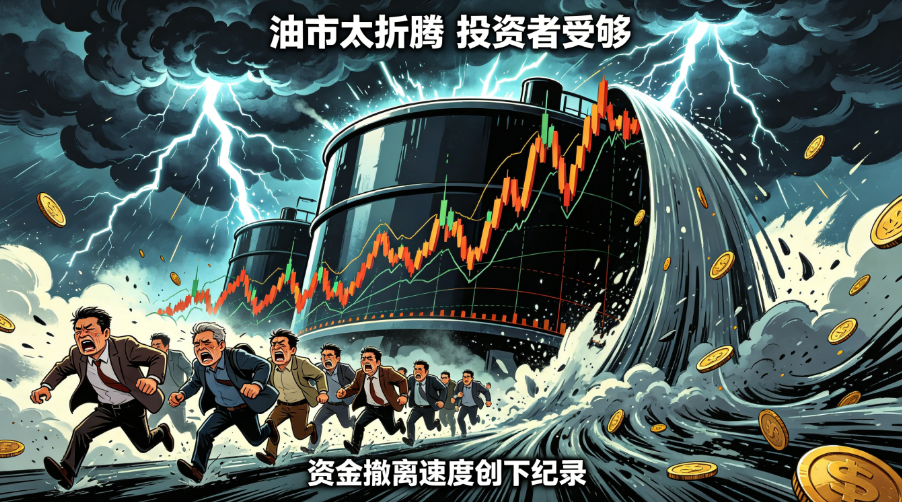
Global oil prices have experienced drastic swings this year, catching traders off guard and causing market liquidity to dry up at the fastest rate on record. Investors, increasingly losing confidence in an asset heavily influenced by U.S. President Trump's frequent social media statements on the war in Iran, are pulling out funds. This liquidity crisis not only reflects the accumulation of geopolitical risks but also reveals capital's self-protection mechanism under extreme uncertainty.
Evidence of Liquidity Dry-Up
Liquidity, the degree to which buyers and sellers match in quantity, is typically determined by trading volume and open interest. According to LSEG data, investors' open interest in Brent crude oil futures has fallen nearly 17% this year, the largest decline since at least 2009. The Brent August futures (near-month contract), which became the most active at the beginning of this month, saw open interest fall to 534,227 contracts, the lowest since last July. While open interest typically declines as a contract approaches expiry, the speed of this shrinkage highlights a massive capital flight trend.
When market liquidity becomes thin, due to a lack of counterparties, buyers and sellers are often forced to accept prices far above or below normal levels, amplifying price volatility. While this may bring excess returns to a few speculators, it also magnifies loss risks, creating a vicious cycle—more volatility deters investors; fewer investors worsen liquidity, fueling more volatility.
The Trump Effect and Investor Fatigue
Traders widely believe that Trump's constant threats toward Tehran, followed hours later by claims of an imminent peace deal, coupled with the difficulty of tracking real-world oil supply and demand fundamentals, have caused severe fatigue among investors. An executive at a major trading firm, speaking anonymously, said: 'People are exhausted by this chaos. Trading futures in an environment that changes every hour makes it almost impossible to avoid constant losses.'
Oil prices fell nearly 3% last Friday to their lowest in nearly two months, after Trump called off a planned new round of strikes on Iran last Thursday and said a deal to end the war was close. This sentiment was interpreted by the market as 'too volatile to hold'—Jeffrey Currie, former head of commodities at Goldman Sachs and now senior advisor at Carlyle Group, said on social platform X that the real reason oil prices have failed to rebound significantly above $100/barrel in recent weeks is not ample supply, but what he calls 'capital avoidance.'
Deep Causes of Capital Avoidance
Currie further noted: 'The decline in open interest through 2026 is the most severe on record. Unlike 2022, there is no interest rate shock or sanctions forcing investors out. This time it's capital avoidance.' This analysis hits the core of the issue: the current liquidity dry-up is not due to external coercive factors but investors actively choosing to exit. Even with the Strait of Hormuz nearly closed and supply severely restricted, oil prices cannot hold the $100 mark, indicating capital is unwilling to pay for geopolitical premiums.
At a deeper level, this capital avoidance reflects a loss of investor confidence in policy predictability. When a country's leader can pivot from 'brink of war' to 'peace deal' within hours, the market pricing mechanism loses its anchor. Futures markets, originally intended as risk management tools, have become sources of risk themselves. Institutional investors prefer to risk missing upside rather than sustain losses amid information asymmetry and extreme volatility.
Market Outlook and Risk Warnings
Looking ahead, the recovery of oil market liquidity depends on two key variables: first, whether geopolitical tensions truly stabilize rather than being a short-lived 'fake peace'; second, whether policy uncertainty decreases, allowing fundamental signals to re-dominate pricing. In the near term, given thin liquidity, any sudden news on Iran could trigger violent swings, and traders must be highly alert to technical risks of 'slippage' and 'inability to close positions.'
In the long run, if capital avoidance persists, the oil market may face structural changes: some small participants may be forced out, market concentration may rise, and volatility could further increase. For oil-importing economies, such volatility undoubtedly adds uncertainty to energy costs, affecting macroeconomic stability.
Conclusion
In summary, the global oil market is experiencing a liquidity crisis driven by a combination of geopolitical fluctuations and capital flight. The rapid contraction of open interest, widespread trader fatigue, and expert analysis characterizing 'capital avoidance' together paint a dangerous signal: when investors lose trust in policymakers, even tight supply and demand fundamentals cannot sustain normal market functioning. If a predictable policy environment cannot be restored, oil market turmoil may become the norm, with negative economic impacts continuing to expand.