
Strait of Hormuz Crisis: New Challenges for Global Shipping and Energy Landscape
Introduction
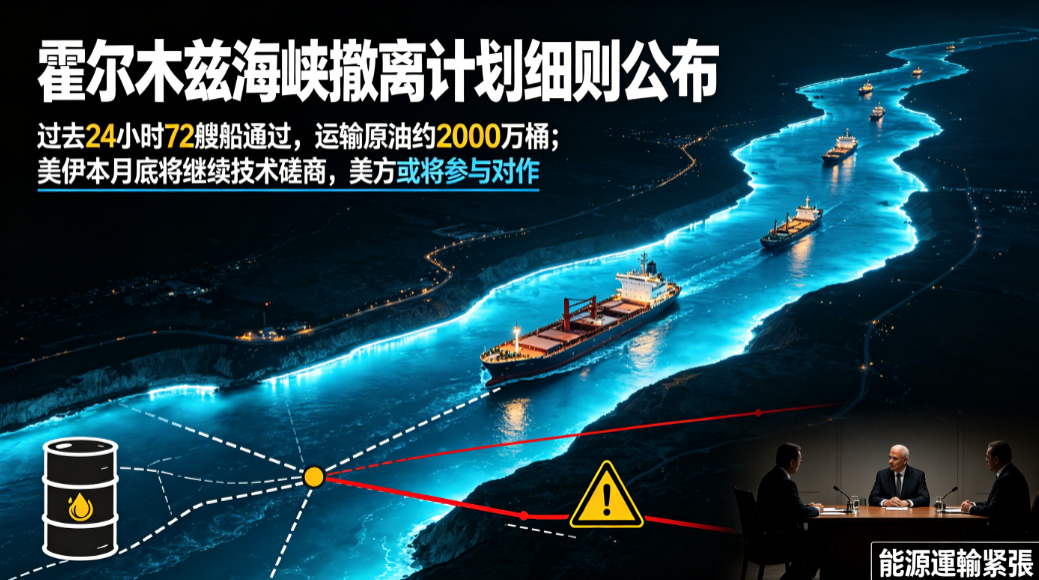
The Strait of Hormuz, one of the world's most critical energy chokepoints, has recently become an international focus due to escalating tensions in the Middle East. On June 24, the International Maritime Organization (IMO) officially released operational details for the Strait of Hormuz evacuation plan, announcing assistance for over 11,000 crew members stranded on ships in the Gulf region to evacuate in phases. Meanwhile, US Energy Secretary Wright revealed that 72 vessels passed through the strait in the past 24 hours, transporting about 20 million barrels of crude oil. This series of developments not only highlights the severity of the current regional security situation but also has profound implications for global energy markets, shipping insurance systems, and international diplomatic patterns. This article provides a comprehensive analysis of the evacuation plan details, energy transport status, economic loss assessments, and US-Iran negotiation progress.
Evacuation Plan Mechanism and Security Challenges
According to IMO details, the evacuation employs a unified coordination mechanism, with Iran responsible for traffic management and navigation coordination on the northern route, while Oman and the US jointly handle the southern route. Notably, due to sea mine threats in parts of the strait, the traditional traffic separation scheme (TSS) has been temporarily suspended, replaced by temporary routes and traffic control measures jointly planned by coastal states. While this adjustment ensures basic vessel passage safety, it undoubtedly increases navigational complexity and time costs.
Statistics show that about 20 million barrels of crude oil successfully transited the strait in the past 24 hours, indicating the waterway remains operational. However, US Energy Secretary Wright emphasized that Iran will henceforth be unable to close the strait, noting it was Iran's "key bargaining chip" and that the US is gradually weakening that chip. This remark suggests the US may have taken covert military or diplomatic measures to ensure strait access, but also reflects the long-term trend of bilateral confrontation.
Economic Losses and Market Turmoil
Global insurance and risk management firm Allianz Commercial released a report stating that as of June 15, the total value of vessels and cargo affected by the Strait of Hormuz "blockage" was approximately $125 billion, with a total tonnage of 29 million gross tons. This data highlights the region's criticality to global supply chains; any disruption would not only expose carriers to huge claims risk but also subject Asian economies dependent on oil imports to soaring energy costs.
Meanwhile, NYMEX crude oil futures fell below $70 per barrel during intraday trading on June 24, the first time since the outbreak of the Iran conflict. This decline can be interpreted from multiple factors: first, market concerns about a complete short-term blockade of the strait have eased; second, the release of US strategic petroleum reserves and expectations of slowing global demand are suppressing prices; third, the resumption of US-Iran technical talks may signal a potential détente. However, with geopolitical risks not fully resolved, oil price movements remain highly uncertain.
US-Iran Talks: Progress and Contradictions
US Secretary of State Rubio stated that US and Iranian technical teams will hold the next round of technical-level talks in Switzerland at the end of June, focusing on nuclear energy, sanctions, and other related issues. US President Trump even claimed that the US would participate in IAEA verification operations at Iranian nuclear facilities. However, Iran has not yet agreed to IAEA access to attacked nuclear facilities, merely stating it "has agreed to inspectors entering," with clear discrepancies between the two sides.
Iranian Foreign Ministry Spokesman Baghaei criticized US officials' statements about the memorandum of understanding as "contradictory" and accused the US government of never showing sincerity in its treatment of the Iranian people. Baghaei stressed that the US must recognize the principle of "reciprocal commitment," requiring both sides to fulfill their obligations and avoid interpretations of the MoU text that are completely contrary to its explicit content. This response reflects Iran's distrust of long-term US violations and foreshadows tough negotiations ahead.
Conclusion
The Strait of Hormuz crisis acts as a mirror reflecting the complex interplay between Middle East geopolitics, global energy security, and international governance mechanisms. While the evacuation plan temporarily eases the crew stranding crisis, sea mine threats affecting temporary route efficiency, oil price volatility impacting economic recovery, and fundamental US-Iran differences over nuclear issues mean the crisis is far from over. Going forward, the international community must continuously monitor regional security dynamics while pushing diplomatic talks toward substantial progress. Only then can the 'bottleneck' risk of the Strait of Hormuz be fundamentally resolved, maintaining the stable operation of the global economic and trade system.