This is an article in Traditional Chinese created based on the provided reference content and image.
New Energy Bases' Consumption Dilemma Meets Solution: 100% Green Electricity Export Technology Demonstration Launched
With the steady progress of China's "Dual Carbon" goals, the construction of new energy bases represented by "Sandy, Gobi, and Barren Lands" and Hydro-Wind-Solar Integration has become a key pillar of energy transition. However, these bases commonly face the severe challenge of "easy generation, difficult export," which not only restricts investment returns but also poses potential threats to the safe and stable operation of the power grid. To break this deadlock, the National Energy Administration recently released a major policy signal, proposing to pilot the demonstration of "100% renewable energy export transmission project," sparking high attention and expectations in the industry.
The Structural Contradiction of "Easy Generation, Difficult Export"
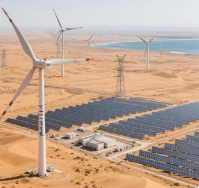
Currently, China's new energy bases are mainly concentrated in the Three North regions' "Sandy, Gobi, and Barren Lands" bases, the southwestern Hydro-Wind-Solar Integration bases, and the eastern deep-sea offshore wind power bases. These base projects are of enormous scale; for example, the existing capacity of the "Sandy, Gobi, and Barren Lands" bases alone is between 200 and 300 GW, and it is expected to reach around 600 GW by 2030. However, behind the massive installed capacity lies increasingly severe consumption pressure.
The chart shows that the utilization rate of centralized new energy consumption has experienced an unusual decline in recent years, and the phenomenon of 'no delivery at low valleys, no transmission at peaks' for cross-regional power transmission has intensified.
As early as 2024, industry experts pointed out that China's new energy utilization rate has been experiencing a rare decline, with centralized new energy already showing "cross-regional transmission 'no delivery at low valleys, no transmission at peaks'." The root cause of this contradiction lies in the volatility of new energy output and the seasonal and time-based mismatch with electricity load. When wind and solar bases are at peak output, it coincides with the low-demand periods of the receiving-end grids in the central and eastern regions, where local distributed new energy is also generating at high levels, leading to reduced demand for imported electricity. Conversely, when the receiving end experiences evening peak demand, the output from wind and solar bases often fails to keep pace. This dual temporal-spatial mismatch causes large amounts of clean electricity to be discarded, resulting in resource waste.
Evolution of Consumption Concepts and New Breakthroughs
To address the consumption challenge in West-to-East power transmission, past approaches mainly focused on increasing the proportion of renewable energy in UHV channels. The "14th Five-Year Plan" specified that this proportion for new channels should be no less than 50%. However, actual implementation has been less than ideal. For some UHV channels, such as Tianzhong and Qishao lines, the renewable energy proportion has long hovered between 20% and 40%. For example, Qinghai's only UHV export channel, the "Qing-Yu DC" line, has a designed annual transmission capacity of 40 billion kWh, but actual transmission in 2023 was less than one-fourth of the designed capacity, highlighting a huge gap between channel utilization and planning targets.
Facing these difficulties, the National Energy Administration on July 10 released the "Energy Sector Energy Conservation and Carbon Reduction Action Plan (2026–2028)," which proposes to orderly promote the planning and construction of clean energy bases and cross-provincial/regional transmission channels, and further proposes to "demonstrate and pilot the implementation of 100% renewable energy export transmission projects." This formulation is groundbreaking, signaling that policymakers are no longer satisfied with "mixed" transmission (i.e., bundled wind-solar-thermal), but are beginning to seriously explore the technical feasibility of long-distance, large-scale, high-proportion export of pure renewable energy. Although currently in the "demonstration and pilot" stage, it fully demonstrates the determination to fundamentally solve the high curtailment rate of large bases.
The Path Forward: From System Engineering to Technology Iteration
Achieving 100% renewable energy export requires solving a series of complex systemic challenges. This involves not only the impact of high volatility of renewable energy on DC channel transmission capacity but also comprehensive consideration of the receiving-end grid's acceptance capability, the competitive interplay of power structures between sending and receiving ends, and the allocation of flexible resources such as supporting energy storage.
The solution path will unfold in two dimensions:
-
"Breaking the Shell" at the System Planning Level: It is necessary to establish a systematic assessment framework covering the entire chain of "power source – transmission channel – receiving end." This means accurately matching the characteristics of base power sources, the dynamic transmission capacity of DC channels, and the tolerance limits of receiving-end grids, promoting multi-stakeholder coordination across all links, and optimizing the timing alignment between capacity planning and construction of export channels.
-
"Leapfrogging" at the Technology Level: 100% renewable energy export imposes extremely high requirements on grid inertia support, frequency stability, and voltage control. The future will rely on integrated applications of technologies such as flexible DC transmission, large-scale energy storage, advanced forecasting, and dispatch control to create a "pure green electricity" transmission system capable of self-balancing, self-adapting, and providing certain inertia support. This also heralds an unprecedented critical battle for new power system technologies.
Conclusion
The demonstration of the 100% renewable energy export transmission project is a bold and necessary attempt in China's energy transition. It is not only one of the "ultimate solutions" to the consumption problem of wind and solar bases but will also drive fundamental changes in planning philosophies, technical standards, and operational models of the entire power system. Although the road ahead is challenging, this policy signal offers a promising path forward.